Monday, 4 October 2010

FORTY EXCUSES FOR NOT JOINING THE ORTHODOX CHURCH


From the universe of western Christians cultural prejudices, ethnic pride, excuses, ignorance and sheer laziness, modeled on the ‘too different’ excuse, I have over the years heard the following:

‘I can’t become Orthodox, because I was born Roman Catholic/Protestant’.
(No, you weren’t. You were born a pagan, like all of us. You were then conditioned and manipulated by a set of ethnocentric cultural values. Look at the Apostles: most of them were born Jews, only they freely changed to Orthodoxy).


‘I can’t become Orthodox, because you don’t have a Pope’.
(You don’t need a Pope; Christ is the Head of the Church)


‘I can’t become Orthodox, because you don’t have the filioque’.
(Nor does the New Testament. See Jn. 15, 26 or Acts 2,33).


‘I can’t become Orthodox, because you don’t have purgatory’
(The Gospel never mentions this Latin word that was first mentioned at the end of the twelfth century).


‘I can’t become Orthodox, because it’s a sect’.
(For nearly 2,000 years, billions of people have not thought so. Are you so much cleverer than all of them?).


‘I can’t become Orthodox, because you have saints’.
(Sadly, that is your loss. Don’t you want to know the friends of Christ?).


‘I can’t become Orthodox, because your way of taking communion is so unhygienic’.
(Then why aren’t Orthodox all constantly ill?).


‘I can’t become Orthodox, because you kiss icons’.
(Don’t you kiss members of your family? Don’t you love Christ and those close to him? Are you not members of the family of Christ? Or are you victims of Protestant scientism?).


‘I can’t become Orthodox, because you have to confess’.
(You mean you have no sins? Then give me your photograph and I will stick it on the iconostasis).


I can’t become Orthodox, because Orthodox are sinners and argue among themselves’.
(Yes, we know about ourselves, that we are sinners. We also think our Faith is important – that’s why we argue, because we are not lukewarm and indifferent. And that’s why we go to church and go to confession and communion, repent, read the Lives of the Saints and find healing for our arguments. You mean you do not know about yourself and your own need to repent?).


‘I cannot become Orthodox, because you don’t sing our hymns’.
(Why sing Victorian platitudes, when you can have ancient spiritual depth?).


‘I can’t become Orthodox, because the choir sings badly’.
(Then come and sing yourself and help improve it).


‘I can’t become Orthodox, because the services are always the same’.
(You mean have never been to more than one Orthodox service in its entirety?).


‘I can’t become Orthodox, because you can’t take part in the services’.
(You mean you have never tried praying?).


‘I can’t become Orthodox, because I will no longer be free to change the Faith and pick from it what I want’.
(You don’t come to the Church to change the Orthodox Faith, you come to the Church to be changed by the Orthodox Faith. Or do you consider that you do not need changing?).


I can’t become Orthodox, because I can pray anywhere, without ritual’.
(And do you? If you can live without ritual, why then do you have a daily routine?).


‘I can’t become Orthodox, because there’s no difference between it and my present religion’.
(Why hesitate then?).


‘I can’t become Orthodox, because it won’t help me’.
(Correct. Nothing will help you, if you don’t first make an effort to improve yourself).


‘I can’t become Orthodox, because you don’t have the same calendar’.
(No, it’s you who don’t have the same calendar).


‘I can’t become Orthodox, because it’s not Western, it’s ‘Oriental’.
(Then it’s like Christ. He came for the Middle East. He wasn’t Western and secular either).


‘I can’t become Orthodox, because I was born English’.
(Nor was Christ. By the way, I didn’t know that ‘English’ was a religion).


‘I can’t become Orthodox, because there are foreigners in church’.
(For racists and xenophobes. As I said, Christ was also a ‘foreigner’).


‘I can’t become Orthodox, because you are so diverse’.
(That’s why we are not boring).


‘I can’t become Orthodox, because the other people are different from me’.
(Are you anti-social? Yet you are different from them and they accept you).


‘I can’t become Orthodox, because the clergy wear beards’.
(So did Christ. More victims of their cultural prejudices).


‘I can’t become Orthodox, because women can’t wear trousers in church and have to cover their heads. It’s like Islam’.
(Yes, like the Mother of God? Or do you think that She was a Muslim? Or do you mean that you have no sense of modesty?)


‘I can’t become Orthodox, because men can’t wear shorts in church’.
(Nor did the Apostles and the saints and your ancestors, when they went to church. Why this need to distract others from prayer by your immodest way of dress?).


‘I can’t become Orthodox, because the services are too long’.
(You mean you are lazy?).


‘The services start too early and finish too late’.
(See above).


‘I can’t be bothered’.
(See above, but thank you for being honest).


‘I can’t become Orthodox, because then I won’t be able to live with my partner any longer’.
(Yes, you will, only you will receive a Divine blessing, your union will become spiritual as well as physical, and your ‘partner’ will become your legitimate spouse, instead of your partner in sin).


‘I can’t become Orthodox, because you have to fast’.
(You mean you reject Christ’s sacrifice of fasting in the desert and his Gospel instructions about freeing yourself from demons through prayer and fasting?)


‘I can’t become Orthodox, because I can’t eat roast beef every Sunday lunch-time’. (You mean you have an all-important passion for meat?).


‘I can’t become Orthodox, because I can’t go to the pub on Saturday nights’.
(You mean you are too weak to stop your drinking bouts?).


‘I can’t become Orthodox, because the priest says that I should try to give up smoking’.
(You mean your passions are stronger than your faith?).


‘I can’t become Orthodox, because I don’t believe in God’.
(I understand. But how do you know? When you were surprised, I heard you calling on God’s name. If you start searching now, you will find faith and then be able to become Orthodox. Seek and you will find).


‘I can’t become Orthodox, because my family will reject me’.
(I understand you. But are you sure? In any case, Christ will not reject you).


‘I can’t become Orthodox, because I do not live near an Orthodox church’.
(I understand you. Change your way of life, so that your priorities are based around the Church).


‘I can’t become Orthodox, because I don’t understand anything’.
(If you want to understand something, then begin by praying about it).


Or my favorite:

‘I can’t become Orthodox, because you have to stand and pray’.
(You mean you can’t be bothered. At least this is not an excuse, but honest).Top of For
Top of For

Monday, 16 August 2010

St. Tatiana of Beijing


10 Juni
Troparion (Irama 3)
“Marilah kita kawanan domba Kristus dengan cinta dan kesalehan, memuliakan dengan kidung sukacita bagi Martir yang setia dengan kebenaran yang menderita bagi Kristus di Cina. Karena mengaku Iman, mereka semua berani pergi kepada kematian sebagai domba-domba, yang dikorbankan untuk Gembala kita Kristus Sang Baginda.  Oleh karena itu untuk para martir kami berseru, "Ingatlah akan kita semua, yang menyanyikan pujianmu".

St. Tatiana adalam istri imam Orthodox pertama di Beijing Cina, St. Mitrophan. Anggota keluarganya ada  diantara para martir  selama gerakan Boxer anti-Kristen pada tahun 1900. Keluarganya berada diantara umat gereja Orthodox Beijing yang sedang berkumpul diaantara puing-puing gereja mereka yang dibakar, ketika mereka diserang. Sebelum dibunuh oleh para pemberontak Boxer itu,  St Tatiana dan St Mitrophan sempat menyaksikan penyiksaan dan kematian Ioann, anak mereka yang baru berusia delapan tahun. Mereka memotong hidung, telinga, dan jari kaki, tapi Ioann tidak meratap atas penderitaannya, dengan penuh keajaiban di tiak merasakan kesakitan akan penderitaannya.  Algojo yang memotong-motong bagian tubuhnya itu mengatakan bahwa ia adalah anak setan.  Menanggapi perkataan algojo itu, Ioann anak yang baru berusia 8 tahun itu berkatan, "Saya seorang Kristen Ortodoks dan saya percaya dalam Kristus, bukan setan"
Kemudian St. Tatiana bersama dengan Isaiah anaknya yang berusia 23 tahun , dibantai dan mereka pun menerima mahkota kemartiran. Tidak lama setelah itu, St.Mitrophan pun ditikam sampai mati.. Tunangan Isaiah, Maria, tiba di reruntuhan gereja itu. Dia membantu banyak orang melarikan diri dari pembantaian itu dengan melompat dinding taman, tetapi dia tetap tinggal untuk menghadapi musuh-musuhnya. Dia memilih untuk mati dengan keluarga tunangan nya. Mereka menusuk kaki dan tangannya dan mendorongnya untuk menyangkal imannya. Dia menolak dengan mengatakan, "Saya lahir di sini di Gereja Kudus Bunda Allah, aku akan mati di sini juga." 222 orang dari 1000 umat paroki Beijing menerima mahkota-mahkota kemartiran pada hari itu.

June 10th
Troparion (Tone 3)
Let us the flock of Christ with love and piety now glorify with hymns and truly joyous odes the faithful Martyrs of the truth who suffered for Christ in China. For having confessed the Faith, they all bravely went to death as lambs, which were sacrificed for our Shepherd and Master Christ. Therefore to the Martyrs we cry out, "Remember us all, who sing your praises".

St. Tatiana.was the wife of the first Orthodox Chinese priest in Beijing, St. Mitrophan.  Her family members were among the first to enter into martyrdom during the anti-Christian Boxer movement in 1900.  Her family as well as many parishioners of the Beijing church were gathered in the burnt-out remains of their church, when they were attacked.  St. Tatiana and St. Mitrophan first saw the torture and death of their eight year old son, John.  They cut off his nose, ears, and toes, but John refused to wail or moan.  By a miracle, he felt no pain.  In response to his executioners accusations of him being a demon-child, John simply stated, "I am an Orthodox Christian and I believe in Christ, not in demons".  Then St. Tatiana, along with her twenty-three year old son, Isaiah, were slaughtered and thus received their crowns of martyrdom.  St. Mitrophan was stabbed to death shortly there after.  Isaiah's betrothed, Maria, arrived at the church soon after.  She helped many escape the churchyard massacre by jumping the garden walls, but she stayed to face her enemies.  She chose to die with the family of her betrothed.  They pierced her feet and hands and encouraged her to give up the Faith.  She refused saying, "I was born here at the Church of the All-Holy Mother of God, I will die here too."  Two hundred and twenty-two of the nearly thousand members of the Beijing parish received their crowns of martyrdom that day.  

Sunday, 15 August 2010

St. Mitrophan of China


Our righteous father, hieromartyr Mitrophan Yang (1856-1900)  
He was one of the many martyrs of the Yihetuan Movement (Boxer) Uprising
Commemoration day June 11

St. MITROPHAN. Priest Mitrophan, his Chinese name being Yang Ji , was born in 1855, on the 10th day of the 12th month . Before reaching twenty years of age, he was appointed to the post of catechist. At 25 he was ordained to the priesthood by Nikolai, bishop of Japan. He lost his father in early childhood and was raised under the care of his grandmother Ekaterina and his mother Marina; his mother was a teacher at a school for females. At the time he experienced many troubles. When Archimandrite Pallady became head of the Mission for the second time, he charged his teacher Juren, Long Yuan to take great care in educating Mitrophan, in order to prepare him for eventual ordination. Mitrophan was a humble person, very cautious and quiet, peaceful and not impassioned; even when faced with great insults, he did not try to justify himself. 


Archimandrite Pallady's successor was Archimandrite Flavian, who later became Metropolitan of Kiev. From the time of his arrival in Beijing, Archimandrite Pallady charged him, as well as the teacher Long Yuan, to try to have Mitrophan attain what had been predestined (that is the priestly rank). Mitrophan did not want to accept ordination and constantly refused, saying "how can a person with insufficient abilities and charity dare to accept this great rank?" But under the forceful urging of Archimandrite Flavian and the persuasion of the teacher, Mitrophan obeyed, even though he knew that by accepting priesthood, his end would be inauspicious. Under Archimandrite Flavian, Priest Mitrophan assisted him in translating and checking books. For fifteen years, he tirelessly served God, while suffering many hurts and insults both from his own people and outsiders, he finally had a mild breakdown. Sometime after this spent three years living outside the mission, receiving half of his previous salary. All his life the Priest Mitrophan was not avaricious and many took advantage of this. 

In 1900, on the evening of June 1 (which was the 17th day of the 5th month on the Chinese calendar)  , the Boxers burned the Mission's buildings. Many Christians, hiding from danger, assembled in Priest Mitrophan's home. Although Fr. Mitrophan's former ill-wishers were among them, he did not drive them out. Seeing that some people were dispirited, he strengthened them, saying that the time of troubles had come and would be difficult to avoid. He himself several times daily went to look at the burned church. On the 10th of June, towards 10 in the evening, soldiers and Boxers surrounded Fr. Mitrophan's dwelling. Up to 70 Christians were there at the time; the stronger among them fled, while Fr. Mitrophan and many others, primarily women and children, remained and were tortured. Fr. Mitrophan sat in his courtyard when the Boxers punctured his chest like a honeycomb and he fell under a date tree. His neighbors removed his body to the Mission's almshouse. Later the Priest-monk Avraamy picked up Fr. Mitrophan's body and, in 1903, during the first commemoration of the martyrs, it along with others, was placed under the altar in the martyrs' church. At the place were Fr. Mitrophan was tortured, there were also: wife Tatiana , and three sons -- the older, Isaiah; the second Sergiy -- now a priest; and the third Ioann. 


 St. Mitrophan of China, pray for us to Christ our God for His Great Mercy!

Tuesday, 11 May 2010

St. Leandro of Seville


San Leandro of Seville
San Leandro ( St. Leander ), a close friend of St. Gregory the Great, was born in Carthagena to a family of high nobility. He was the eldest brother of several saints. His brother, St. Isidore, succeeded him as Bishop of Seville. Another brother, St. Fulgentius, became Bishop of Carthagena, and his sister, St. Florentina, became an Abbess in Carthagena.

St. Leander of Seville
When he was still young, Leandro retired to a Benedictine monastery where he became a model of learning and piety. In 579 he was raised to the Episcopal see of Seville, where he continued to practice his customary austerities and penances.

At that time, a part of the territory of Spain was dominated by the Visigoths. Those barbarians were Arians and had spread their errors in the cities they had conquered. The Iberian Peninsula had been infected by that heresy for 170 years when  Leandro was chosen Bishop of Seville. He began to combat it immediately. With the help of God, to Whom he had recourse, his efforts were successful and the heresy began to lose hold on its followers. He also played an important role in the conversion of Hermenegild, the eldest son of the Visigoth King.

King Leovigild, however, became angry over his son’s conversion and Leandro’s activity. He exiled the Saint, and condemned his son to death. Later, he repented, recalled the Saint to Spain and asked him to educate and form his other son and successor, Reccared, who became a Christian  and helped the Saint  to convert the rest of his subjects.

Leandro played a central role at two councils, the Council of Seville and the Third Council of Toledo, where Visigothic Spain abjured Arianism in all its forms. He also wrote an influential Rule for his sister with instructions on prayer and renunciation of the world. He reformed the liturgy in Spain, adding the Nicene Creed to the Mass in order to make an express profession of the Faith against Arianism. Later, this practice passed to other Orthodox countries. He died in 596.

Venerated by Eastern Orthodox Church, also by Rome Catholic

Friday, 7 May 2010

"The Saint who walks" - Father of Serbia Patriach Pavle


"The Saint Who Walks"
"I am said to be leading the Serbs into a war for the preservation of Great Serbia.
However, if the preservation of Great Serbia requires crime -- I refuse it, may Great Serbia be gone.
If the preservation of little Serbia requires crime -- again, I refuse it, may little Serbia be gone.
If the preservation of even a single Serb requires crime -- again, I refuse it, may all of us be gone."

Lahir pada tanggal 11 September 1914 , beliau telah ditakdirkan menjadi pemimpin rohani seluruh orang Serbia Orthodox, beliau lahir di desa Kucani distri Donji Miholjac,  Slavonija, yang pada saat itu merupakan bagian kekaisaran Austro Hungaria, yang kini Kroasia.

Nama baptisnya adalah Goyko, lahir dari orang tua bernama Stefan dan Ann Stojcevic. Ia dibesarkan oleh bibinya yang memberinya pendidikan yang sangat baik.
Selama Perang Dunia II, ia harus melarikan diri ke rumah masa kecilnya, dan mencari perlindungan di biara Tritunggal Mahakudus di Ovcar. Dia kemudian mengambil kaul monastik di Biara Blagovestenje juga di Ovcar, di mana ia mengambil nama monastik Pavle (Paul).


Ia terpilih  menjadi Uskup Ras dan Prizren ( yang mencakup seluruh Kosovo ) pada tahun 1957 dan memegang posisi tersebut selama 33 tahun sebelum terpilih menjadi Patriarch tahun 1990


Patriarch Pavle was deply pained by the Mammonic spirit that became dominant in Serbia in the aftermath of the collapse of communism: “I wish I could stand and beg outside the banqueting halls and other gathering venues of the rich, beg for our poor brothers and sisters and their children. We should actively shame those who sink into arrogant greed so openly, instead of expressing our anguish behind closed doors.” His proverbial modesty was reflected in his use of public transport and dislike of chauffeur-driven cars. During the Assembly of Bishops in 2006 he walked our of the Patriarchate and saw a long line of shiny black Mercedes-Benz, Audi and BMW cars parked outside the building. “Who do these belong to?” Pavle asked his secretary. “Em, to the Bishops who came to the Assembly, Your Grace.” “I only wonder,” the Patriarch commented, “what would they have driven if they had not taken the vow of poverty…”
Serbia was blessed with several politically astute Patriarchs in some critical moments of its history, notably Arsenije III (Charnojevich) at the time of the Turkish wars and Great Migration of 1690, and Gavrilo (Dozhich) during World War II.
+Patriarch Pavle , Metropolitan Christopher of Libertyville, IL St. Sava Monastery, 
+pokojni Bishop Stefan of Zica; behind the Patriarch is Bishop Irinej of Nis, the CURRENT Patriarch

Patriarch Pavle belonged to a different tradition. He was a mystically prayerful monk, rather than a sanguine Prince of the Church. He was a Patriarch who blended, harmoniously, three key functions of his throne: that of the father, of the priest, and of the prophet. He understood, and lived, the legacy of Prince Lazar, martyred at Kosovo in 1389: “The Kingdom on Earth is but paltry and small; yet the Kingdom of Heaven is forever and knows no bounds.


Testimony for the fallen in sleep +Patriarch Pavle from Ecumenical Patriarchate of Constaninople:

"His face and appearance were radiant with holiness and righteousness. He was a true monk, a man of endless prayers, kind and calm but also a fighter who does not back down and is ready for any sacrifice when needed."
"People of Serbia, begin weeping, sobbing bitterly and expressing your sorrow according to his merit, a theologian of broad knowledge, a merciful, peaceful man of open views." 
Patriarch Batholemew I  


 Some pictures of the funeral + Patriarch Pavle


"Patriarch Pavle's death is no reason to be sad because the Patriarch always had sought to reach out to God. He has been more in heaven than on earth. The Serbian people now have someone to represent them before God better than anyone else."  


 + Patriarch Pavle
(1914-2009)

"Let us guard against inhumans, 
but let us guard even more against becoming inhuman ourselves." 
+ Patriarch Pavle

Patriark Pavle: Seorang Santo Yang Berjalan Kaki

oleh Danny Abbott

Umat Kristen Orthodox kehilangan seorang uskup yang tak kenal takut dengan kematian Patriark Pavle pada tanggal 15 November, pemimpin dari Gereja Orthodox Serbia yang memimpin sekian lamanya. Seorang dengan kerendahan hati luarbiasa dan suara yang tak kenal lelah mendengungkan perdamaian di Balkan, ia dikenal luas oleh sebangsa dan setanah airnya, bangsa Serbia, dan banyak yang lainnya sebagai seorang santo yang hidup.

Lahir dengan nama Gojko Stojcević di Kroasia, dan telah menjadi yatim piatu, ia diasuh oleh bibinya. Ia lulus dari sebuah gymnasium (sekolah senam) di Belgrade, kemudian kuliah di seminari Sarajevo. Pada masa Perang Dunia II, ia mengungsi di Biara Tritunggal Mahakudus Ovcar. Setelah perang itu, ia bekerja sebagai pekerja konstruksi di Belgrade, kemudian memasuki kehidupan monastik di biara Blagoveštenje di Ovcar dimana ia memakai nama Pavle. Ia mengajar di Seminari Prizen, kemudian pergi ke Athena mempelajari Perjanjian Baru dan Liturgi selama dua tahun, dan menulis begitu banyak hal yang terkait dengan Liturgi.

Pada tahun 1957, ia ditahbis arkhimandrit dan berikutnya di tahun itu dikonsekrasi sebagi uskup Keuskupan Raška and Prizen. Di masa ini, ia mulai berbicara mengenai munculnya masalah di wilayah Balkan dan kondisi buruk yang terjadi di Kosovo. Pada tahun 1990, ia menjadi Patriark. (lembaran-lembaran kertas berisi nama-nama dari tiga calon diletakkan di atas altar. Dua tertiup pergi [dia saja yang tersisa; dengan demikian dia terpilih]).

Satu dari sekian banyak tanda keketatannya pada komitmennya untuk kehidupan asketis adalah penolakannya untuk memiliki atau menggunakan mobil. Ia menegaskan bahwa ia akan memiliki mobil pribadi hanya setelah dia menjadi orang yang terakhir di Kosovo yang tidak punya mobil. Hasilnya, ia seringkali disebut sebagai “santo yang berjalan kaki.” Sebagai Patriark, Pavle seringkali terlambat untuk mengunjungi paroki karena ia bersikeras untuk memakai bis.

Pada tahun 1989, di saat hubungan antara etnis Albania dan Serbia bertambah tegang, ia didera oleh sekelompok orang Albania dan diopname beberapa bulan lamanya. Ia menolak untuk menuntut balik para penyerang itu.

Di tahun-tahun penuh konflik yang buruk di Balkan, tekanan pihak barat, yang mengabaikan kata-kata dan tindakan Pavle, seringkali menuduhnya tidak mampu mengatasi nasionalisme bangsa Serbia yang tak terkendalikan.

“Jikalau kita hidup sebagai umat Allah,” katanya dalam sebuah pernyataan yang tidak dipublikasikan secara luas, “ada ruang bagi semua bangsa di Balkan dan di dunia. Jika kita menyamakan diri kita dengan Kain yang membunuh adiknya Habel, maka segenap dunia ini akan sangat kecil bahkan untuk dua orang. Tuhan Yesus Kristus mengajar kita untuk senantiasa menjadi anak-anak Allah dan mengasihi sesama manusia.”

Keinginan Pavle bagi perdamaian antar etnis di wilayah Balkan jelas dan nyata kepada semua yang mengenal atau yang bertemu dengannya. Ketika Jim Forest, sebagai sekretaris dari Persahabatan Damai Orthodox, pertama kali bertemu dengannya pada tahun 1994, Pavle mengingat kembali persahabatannya yang langgeng bersama dengan orang Yahudi dan Muslim di masa mudanya, secara khusus ketika ia tinggal di Sarajevo. Ia menegaskan kesediaannya “kapanpun itu” untuk bertemu dengan siapa saja yang dapat membantu membawa Balkan “satu sentimeter lebih dekat kepada perdamaian.”

Sementara ada imam bangsa Serbia yang menjadi partisan dalam konflik yang memecah Yugoslavia, Pavle tidak pernah memaafkan atau mengesahkan siapa saja untuk ikut serta dengan kelompok manapun yang mencucurkan darah atau perkenanan dukungan imam manapun pada senjata siapapun itu. Ia menyatakan pada tahun 1995, “berkenaan pada kejadian yang tiada henti terjadi pada republik-republik pecahan Yugoslavia, perkenaan atas senjata hanya dapat dianggap atau diterima sebagai dukungan penggunaan senjata dalam sebuah perang fratricidal.”

Pada sebuah kesempatan ia melanggar tradisi kenetralan (ketakberpihakan) Gereja berkenaan pada masalah pemerintahan dengan terang-terangan menentang Milošević.

Di awal tahun 90-an, Vuk Drašković, kini menjabat Wakil Perdana Mentri Serbia, adalah diantara politisi-politisi pertama Serbia yang menyalahkan pemerintahan Milošević sebagai kejahatan perang. Ia dan istrinya dianiaya dengan sangat keji dan dipenjarakan karena pendirian mereka. Pada tahun 1993, Pavle menulis surat kepada Milošević meminta pembebasan Drašković’. Pada tahun 1997, sang Patriark memimpin suatu barisan anti pemerintah, yang mencegah serangan polisi pada pemrotes para pelajar.

Tahun 2000, Pavle menyerukan kepada Slobodan Milošević untuk mundur. Segera setelah pemerintahan pimpinan Milošević digeser dari kekuasaan, Pavle disambut pemerintahan baru.

Kontribusi Patriark Pavle kepada Gereja Orthodox tak terkira banyaknya. Jumlah bahan yang ia tulis pada berbagai topik seperti liturgi dan pesta-pesta perayaan tersebar dalam berbagai buku. Selain itu, ia mengawasi sebuah penterjemahan Perjanjian Baru ke dalam bahasa Serbia tahun 1984. Ia mampu merekatkan kembali skisma Gereja Serbia dengan Gereja Orthodox Serbia Bebas dan tanpa kenal lelah berupaya untuk merekatkan skisma dengan Gereja Orthodox Makedonia.

Dua tahun kehidupan Pavle yang tersisa dilewatkan di rumah sakit sementara tugas-tugasnya dijalankan oleh Metropolitan Amfilohije. Kematian Patriark Pavle diikuti oleh masa berkabung nasional selama tiga hari.

Setelah kematiannya, ucapan belasungkawa dikirim oleh Paus Banediktus, para pemimpin Yahudi dan Muslim, dan para pemimpin yang mewakili segenap dunia Orthodox. Patriark Bartholomeus dari Konstantinopel berkata: “Tak seorangpun di era hiruk pikuk ini yang berbicara begitu lembut dan yang didengarkan begitu luasnya sebagaimana dia. Tak seorangpun yang berbicara sedikit namun mengatakan lebih. Tak seorangpun di abad penuh hayal kita ini yang meramu kebenaran dengan kelembutan seperti dia.”

Danny Abbott menerima gelar hukumnya dari Universitas Arkansas. Ia adalah anggota dari Gereja Kristen Orthodox St. Elizabeth Martir Baru di Murfreesboro Tennessee.

Wednesday, 5 May 2010

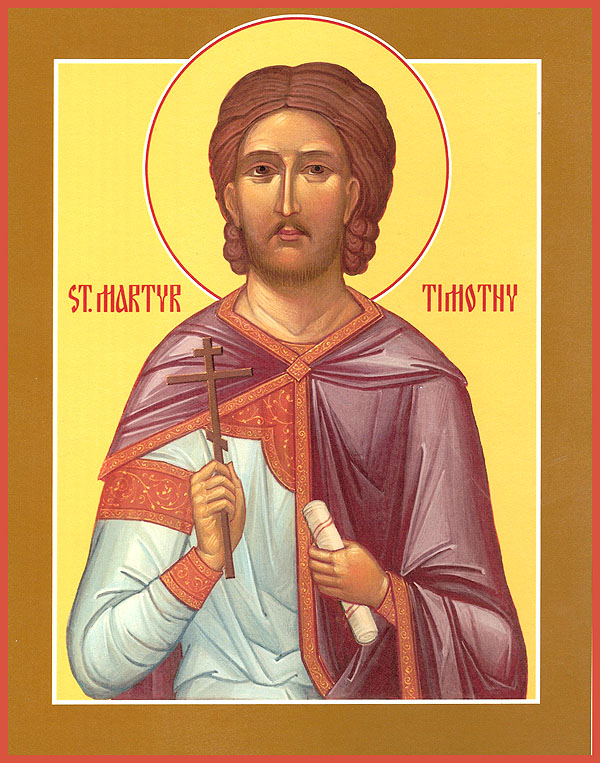
Holy Martyr St. Timothy and St. Mavra - 3 May


Sts. Timothy and Mavra the Martyrs (Feast Day - May 3)

A holy couple, Saints Timothy and Mavra, suffered for the faith at the hands of idolaters. By this they became examples of sacrifice, love and dedication to our Lord, God and Savior Jesus Christ.

During the Marriage Service, after the couple has been crowned, we sing the following hymn to all the Holy Martyrs ( see :40 Martyrs of Sebastea ): "O holy martyrs, who fought the good fight and have received your crowns: Entreat ye the Lord, that He will have mercy on our souls." We sing this because it characterizes marriage as a martyrdom, since it is a Mystery of love. Love by nature is martyric, it is a cross. For two strangers to come together from two different worlds with two different backgrounds and personalities, as well as different flaws, weaknesses and upbringings, and to live their lives with much patience and love towards each other, indeed requires much sacrificial and martyric love.

Saints Timothy and Mavra embody this love and their lives should be an inspiration for every married couple, with their icon hanging in their home as a reminder of what a Christian marriage is all about.


The holy and glorious martyrs Timothy and Mavra  were a newly-married Christian couple who suffered martyrdom in the year 286, under Arianos, the pagan governor of Thebaid, during the reign of Diocletian, in Thebes, Egypt. The Church celebrates their feast day on May 3.

Under some accounts Timothy was a priest of the Church, but in most he was a reader. He was married to Mavra, a devout Christian woman from a very pious Christian family. Timothy was known for his great piety and knowledge of the Holy Scriptures. Many times at night after the day's work, villagers would gather around Timothy where he would read to them from the Scriptures.
After only 20 days of marriage, Timothy was summoned to the pagan governor Arianos, to be brought to trial for his Christian teaching and missionary work. At first, he was asked to surrender all of his sacred books in order for them to be destroyed. Timothy refused, for he knew their value and power. "If a father who loves his children," he said, "and who obeys the natural law does not deliver up to death his fleshly children, how can I give over my spiritual children, the sacred books, into your polluted hands?" He was punished harshly and inhumanely for his courage but he regarded the tortures as honors, since they would bring him eternal bliss. The governor commanded that Timothy be pierced through the ears with iron rods, so that the pupils of his eyes leapt out with the pain. He was also hanged by his feet and his mouth was stuffed with wood. His wife also was cruelly tortured after she was asked to use her "womanly gifts" to persuade her husband to deny Christ. Instead, she gave Timothy strength and encouragement during his suffering. This enraged Arianos even more and he began to think of even more barbaric tortures. Mavra's hair was pulled out and her fingers were cut off. As she was being tortured, she prayed for her tormentors. She was then put in a cauldron of boiling water which did not affect her. 


During all of these tortures, the saints both saw visions of angels which comforted them. As they were both led to their death by crucifixion, they both kissed their crosses on which they were to be martyred. Nailed to their crosses facing each other, each comforted the other for nine days as they hung. After nine days of hanging on their crosses glorifying the Lord, these newlyweds gave up their souls and entered eternal life. They beheld a vision of angels pointing to thrones in heaven next to Jesus Christ waiting for them.